

Earth-Scale Problems, Earth-Scale Data: Cerulean’s Bet on Planetary Intelligence
Cerulean invests in LGND.AI

LGND.AI is delivering new earth and ocean insights at scale. The hardest problems facing ocean and terrestrial ecosystems don’t respect borders. Coral bleaching doesn’t stop at national waters. Whale migration corridors span hemispheres. Illegal fishing fleets operate in the gaps between jurisdictions. If you want to protect, restore, and understand living systems at the scale they actually exist, you need technology and data that are just as global — and just as alive.
This is why Cerulean invested in LGND.AI.
What LGND.AI Actually Does
LGND.AI (along with its affiliates Clay and Ode) is building the intelligence layer for the physical world — turning Earth observation data, remote sensing, and decades of scientific field work into navigable, actionable platforms. The team combines data scientists, EO/GIS experts, and ML engineers working alongside some of the world’s leading researchers to answer a deceptively simple question: what is actually happening to this planet?
Two of their answers just got nominated for Webby Awards.
Blue Corridors — Safe Passage for Whales and Dolphins
In collaboration with WWF, the WWF Protecting Whales & Dolphins Initiative, the University of Southampton, and more than 60 partners worldwide, the LGND.AI team has spent years tracking, visualizing, and bringing decades of whale migration data to life. The result is Blue Corridors — a platform that maps the routes great whales and dolphins travel across ocean basins, helping scientists, policymakers, and conservationists identify where these animals are most vulnerable to ship strikes, entanglement, and acoustic disruption.
It is gorgeous. It is scientifically serious. And it is nominated for a Webby in Best Data Visualization.
Ocean Central — How Is the Ocean Actually Doing?
The answer, it turns out, is complex. OceanCentral.org tracks marine life abundance, ecosystem coverage, pollution, climate impact, and more across six global indicators — making some of the most important ocean health data in the world navigable on the open internet. Not locked behind a research institution. Not buried in a PDF. Searchable, visual, and free.
It’s nominated for a Webby in Sustainability & Environment.
The Momentum Continues
LGND.AI just signed a new partnership with Global Fishing Watch to support its data collection efforts — adding another critical thread to what is becoming a comprehensive intelligence system for ocean health. Translating marine phenomena from Earth observation data at scale remains genuinely hard. But LGND, alongside a handful of other Cerulean portfolio companies, is among the handful of teams on the planet that are actually doing it.
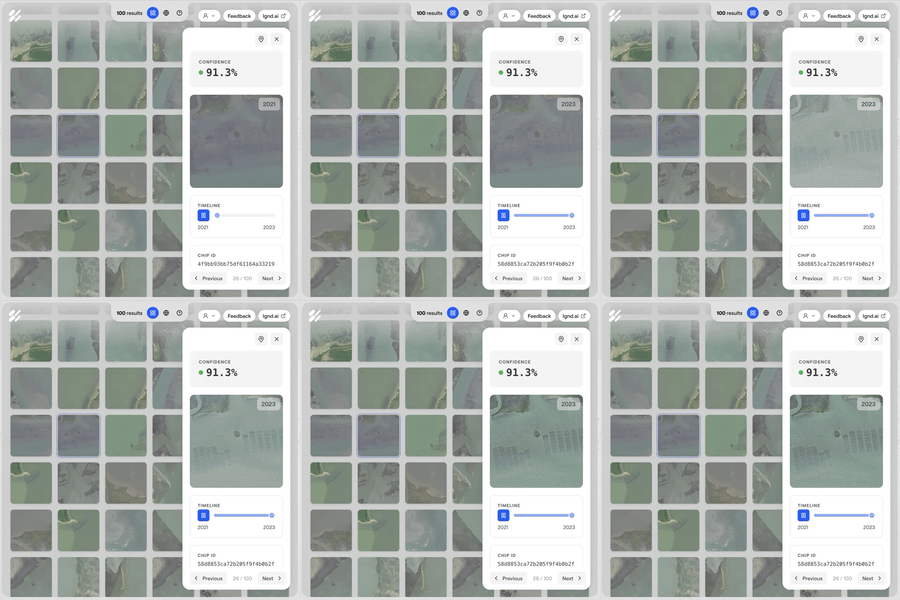
Want to explore the capability yourself? Their free natural language query tool lets you search any ecosystem on Earth in plain English:
(Below is an example query on aquaculture in Virginia — the results speak for themselves.)
Why This Matters for Cerulean
Webby nominations are a signal, not the substance. The substance is this: the problems we are investing to solve — ocean degradation, biodiversity collapse, illegal extraction, ecosystem invisibility — are Earth-scale problems. Solving them requires companies willing to work at that same scale, with the data infrastructure, scientific partnerships, and technical depth to match.
LGND.AI is one of those companies. And it is just getting started.
Cerulean Ventures is a pre-seed and seed stage fund investing in Natural Intelligence — the convergence of applied AI and ecosystem services across nature, energy, food, and ocean systems.